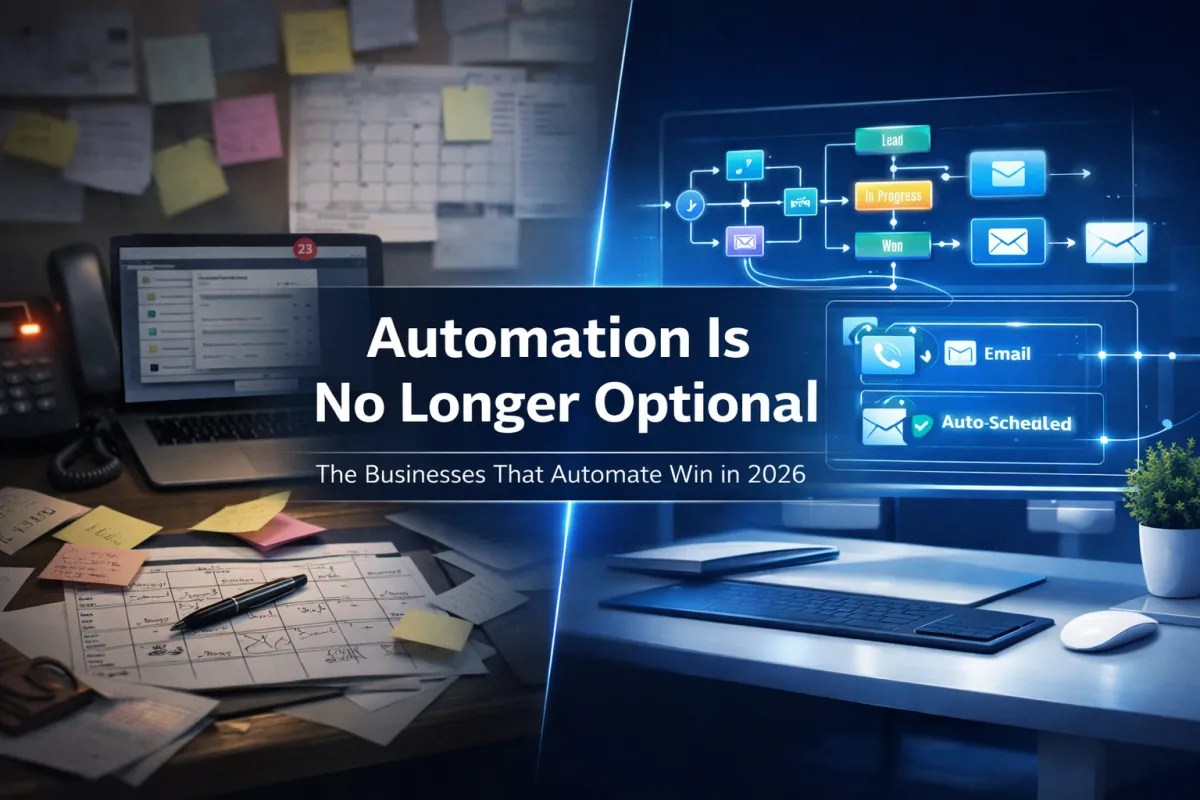
Why Business Automation Is No Longer Optional in 2026
There was a time when automating parts of your business was considered a smart bonus. A nice edge. Something the bigger companies did. That time has passed.
In 2026, business automation is the baseline. The companies that have not yet built automated systems for their communication, follow-up, and lead management are not just behind. They are losing revenue every single day without realizing it.
This guide explains what business automation actually means for small and mid-sized businesses, why it has become necessary rather than optional, which areas of your business matter most, and how to get started without being overwhelmed.
What Business Automation Actually Means
Business automation means using technology to handle tasks that your team currently does manually. This includes things like:
Responding to a new lead when they fill out a contact form
Sending a follow-up message after a sales call
Booking an appointment from a phone call
Requesting a Google review after a service is completed
Moving a prospect through your sales pipeline based on their actions
None of these tasks require a human. Each one can be triggered automatically, handled instantly, and logged without anyone lifting a finger. That is what automation does. It takes your most repetitive, time-sensitive tasks and runs them 24 hours a day, 7 days a week, without error or delay.
It is not about replacing your team. It is about giving your team more time to do work that actually requires a person.
The Numbers That Changed Everything
Business automation has moved from early adoption to mainstream practice, and the data makes clear why.
According to a 2024 workflow automation study, 75% of organizations now view automation as essential for competitive advantage, and the global workflow automation market reached $18.45 billion in 2025. This is not a niche technology trend. It is a fundamental shift in how businesses operate.
A 2024 Bain Automation Pathfinder Survey found that companies with business automation operate with 22% lower costs and significantly faster response times than those still handling tasks manually.
Speed matters more than ever because customers no longer wait. When a prospect submits an inquiry, they are often reaching out to three or four other providers at the same time. The first business to respond tends to win the conversation. If your follow-up system depends on a staff member checking their email, you are likely losing leads to a competitor whose system responds in seconds.
Research from Formstack found that over half of employees spend two hours daily on repetitive tasks. That adds up to more than 500 hours per employee annually. That is time that could go toward serving clients, growing the business, or closing more sales.
Where Most Small Businesses Are Losing Time and Money
Most small business owners are aware that their team spends time on repetitive work. What they often underestimate is how much that time actually costs them.
Here are the most common areas where manual processes create problems.
Lead follow-up. When a new lead comes in through your website, a social media ad, or a missed call, every minute of delay reduces the chance of converting that lead. Studies on sales response time consistently show that the first five minutes after a lead submits an inquiry are the most critical window. Manual follow-up almost never happens within that window.
Appointment scheduling. When booking requires back-and-forth emails or phone calls, some prospects simply drop off. An automated booking system lets them schedule immediately, at whatever hour they decide they are ready.
Customer communication. Sending reminders, confirmations, follow-up messages, and check-ins manually takes hours per week across a team. These communications are predictable and templatable. There is no reason they should require manual effort.
Review collection. A steady flow of positive Google reviews directly affects how many new customers find and trust your business. Most businesses do not ask for reviews consistently because the process feels awkward or time-consuming. Automation removes that friction entirely.
CRM and pipeline management. When your team has to manually update deal stages, tag contacts, or log call notes, important details fall through the cracks. Automated CRM workflows track every interaction and move prospects forward without anyone having to remember to do it.
Each of these areas represents both a time drain and a revenue leak. When you fix them with automation, the improvement shows up quickly.
Why Automation Has Become a Competitive Requirement
In 2024, automation was a competitive advantage. In 2026, it is simply what customers expect.
Customers expect instant responses. They expect to book appointments at 10pm from their phone. They expect follow-up messages that feel timely and relevant. When a competitor provides all of this automatically and your business does not, the difference is visible.
Small businesses that adopted AI automation in 2025 reported handling three to five times more customer volume without proportional increases in staff, along with a 26% average increase in customer satisfaction scores. That gap in capacity and customer experience is now the primary way automated businesses pull ahead.
There is also a staffing reality to consider. Hiring more people to handle growing volume is expensive, slow, and unpredictable. Automation scales immediately. When your lead volume doubles, your automated systems handle twice the workload without any additional cost.
The Core Systems Every Business Should Automate First
If you are new to automation, the goal is not to automate everything at once. Start with the areas that have the most direct impact on revenue.
Voice AI for missed calls and inbound inquiries. Your business receives calls when no one is available. Those calls represent potential customers. A Voice AI system can answer those calls, qualify the caller, and book appointments automatically. The caller gets an instant, professional response. Your team gets a booked appointment in their calendar without doing anything.
Automated SMS, email, and WhatsApp follow-up. When a new lead enters your system, an automated sequence of messages should begin immediately. This might be a confirmation message, followed by a short introduction to your services, followed by a scheduling link. With SMS, email, and WhatsApp automation, these messages go out on a schedule you set once and never touch again.
CRM with automated pipeline management. A CRM tracks every lead from the first contact through the sale and beyond. When it is automated, leads move through your pipeline based on their actual behavior, not on whether someone remembered to update the record. A well-configured CRM and sales pipeline is the foundation of a business that can grow without adding administrative headcount.
Conversational AI for website and social media. When a visitor lands on your website or messages you on Instagram at midnight, what happens? If the answer is nothing until the next business day, you are losing potential customers. A conversational AI handles those interactions instantly, answers common questions, and routes serious prospects to your booking calendar.
Google review automation. After a job is completed or a service is delivered, an automated message goes out asking the customer to leave a review. This one step, done consistently, builds your Google rating over time and directly drives new inbound traffic from people searching for businesses like yours.
What AI-Powered Automation Does Differently
Standard automation follows fixed rules. If X happens, do Y. This works well for predictable tasks.
AI-powered automation adds a layer of intelligence. It can interpret a customer's message and respond with a relevant answer. It can detect when a lead is ready to book and escalate them to a human. It can adjust the tone of a message based on context.
For businesses that handle a high volume of inquiries, this distinction matters. A rule-based chatbot that can only respond to specific keywords will frustrate customers who ask questions even slightly outside its script. An AI-powered system can hold a real conversation, understand intent, and respond helpfully.
This is why the combination of automated workflows and AI communication tools delivers results that neither approach achieves alone. The workflows handle the structure and timing. The AI handles the conversation.
Common Concerns About Getting Started
"My business is too small for this." Automation tools are now priced and designed for small businesses. If you have a phone number, a website, and customers, you have enough to benefit immediately.
"I don't have the technical knowledge." A properly built automation system is set up by experts and then runs on its own. You do not need to understand the technology. You need to understand your business process, and a good automation partner handles the rest.
"My customers want to talk to a real person." They still can. Automation handles the first response, the routine follow-up, and the scheduling. When a customer needs a human, the system routes them to one immediately. The goal is not to remove human interaction. It is to make sure every customer gets a fast, professional response from the first moment, regardless of the time or day.
"I already have too much to manage." This concern gets it backwards. Automation reduces what you have to manage. Once the systems are in place, they handle the repetitive work without your involvement.
How to Evaluate Whether Your Business Is Ready
Ask yourself these questions honestly.
Do new leads receive a response within five minutes? Do you have a consistent process for following up with prospects who did not convert the first time? Does your team spend time on tasks that happen the same way every time? Do you collect Google reviews from every satisfied customer? Do you know exactly where every lead is in your sales process right now?
If the answer to any of these is no, automation addresses those gaps directly. These are not complex problems. They are process problems, and process problems have process solutions.
The Cost of Waiting
Every month without automation is a month of lost leads, inconsistent follow-up, and hours of manual work that cost money. The businesses that move first build an operational advantage that compounds over time. Their systems get tuned and optimized. Their review count grows. Their response times stay fast. Their team stays focused on work that requires human judgment.
According to research from McKinsey on the state of AI in business, 67% of small businesses using AI automation saw revenue growth of 20% or more in 2025, up from 41% in 2023. That adoption curve is accelerating. The gap between businesses that have automated and those that have not is getting wider every month.
You do not need to automate everything. You need to start. Pick the most painful bottleneck in your business right now and automate that first. Then build from there.
If you want to understand exactly which systems would make the most impact for your business specifically, book a free 15-minute discovery call. The conversation is practical and direct. You will leave with a clear picture of what automation would look like for your business and what it would cost


