Automate Google Reviews & Boost Local Rankings | GoFullAI
Most service businesses know they need more Google reviews. They ask customers occasionally, get a few here and there, and then the process stalls. A month passes with no new reviews. Another month goes by. Meanwhile, a competitor down the street is collecting reviews consistently, showing up higher in local search results, and winning more customers without spending more on ads.
The problem is not that your customers are unwilling to leave reviews. Most satisfied customers will leave a review if you ask them at the right moment, through the right channel, with the right message. The problem is that manual outreach is inconsistent. It depends on someone remembering to ask, finding the time to send a message, and following up if the first request goes unanswered.
Automated Google reviews fix that. This guide explains why Google reviews matter more than ever for local rankings, what makes review collection fail without a system, and how automation turns a frustrating manual task into a steady, reliable process.
Why Google Reviews Have Become a Local Ranking Signal
Google reviews are not just social proof for customers. They are a direct input into how Google ranks your business in local search results.
Review signals can account for over 15% of how a business ranks in the local pack. The local pack refers to the group of three business listings that appear near the top of Google search results when someone searches for a service near them. Appearing in that pack drives significantly more traffic and customer actions than ranking anywhere below it.
Google Reviews contribute 15% to Local Pack rankings, with businesses having higher review counts consistently ranking better in local visibility. Appearing in the Google Local Pack generates 93% more user actions for featured businesses versus non-featured ones.
Beyond rankings, reviews directly influence whether a prospect chooses your business over a competitor. A company with a 4.5-star average can earn up to 25% more clicks compared to one with a 3.5 rating. That difference in click-through rate compounds over time. More clicks mean more calls, more bookings, and more revenue.
Positive Google reviews are linked to up to 18% revenue growth, and appearing in the Google 3-pack yields approximately 126% more traffic and 93% more actions than positions 4 through 10.
The data is clear. Google reviews are not a nice-to-have for local businesses. They are a primary driver of local visibility, customer trust, and revenue.
What Makes Reviews Drop Off Without a System
Most businesses understand that reviews matter. The challenge is building a process that actually delivers them consistently.
Here is where manual review collection breaks down.
Timing is off. The best moment to ask for a review is immediately after a customer has a positive experience. When a service is complete, the experience is fresh and the customer is satisfied. Waiting even a day or two reduces the likelihood that they will follow through. Manual outreach rarely happens at the optimal moment because it depends on someone remembering to reach out.
Volume does not scale. A single team member handling review requests can only do so much. As the business grows, the gap between satisfied customers and review requests grows too. There is no way to maintain a consistent cadence manually when the team is focused on delivering services.
Recency requirements are strict. 73% of consumers only trust reviews from the last 30 days, and 83% say recency is essential for trust. This means a batch of 50 reviews collected in one month does not help you next month. Google and customers alike respond to a continuous, steady stream of new reviews. A burst-and-pause approach fails on both fronts.
Follow-up never happens. Most customers who mean to leave a review simply forget. One message is rarely enough. Without a follow-up sequence, a large percentage of willing reviewers never complete the action.
There is no visibility into what is working. Without tracking which customers were asked, which responded, and which converted, the business has no way to improve the process or know which channels perform best.
Every one of these problems has a direct solution in an automated review system.
How Automated Google Reviews Work
Automated review collection uses triggers, timing, and multi-channel messaging to request reviews from the right customers at the right moment without any manual involvement from your team.
Here is how the process works step by step.
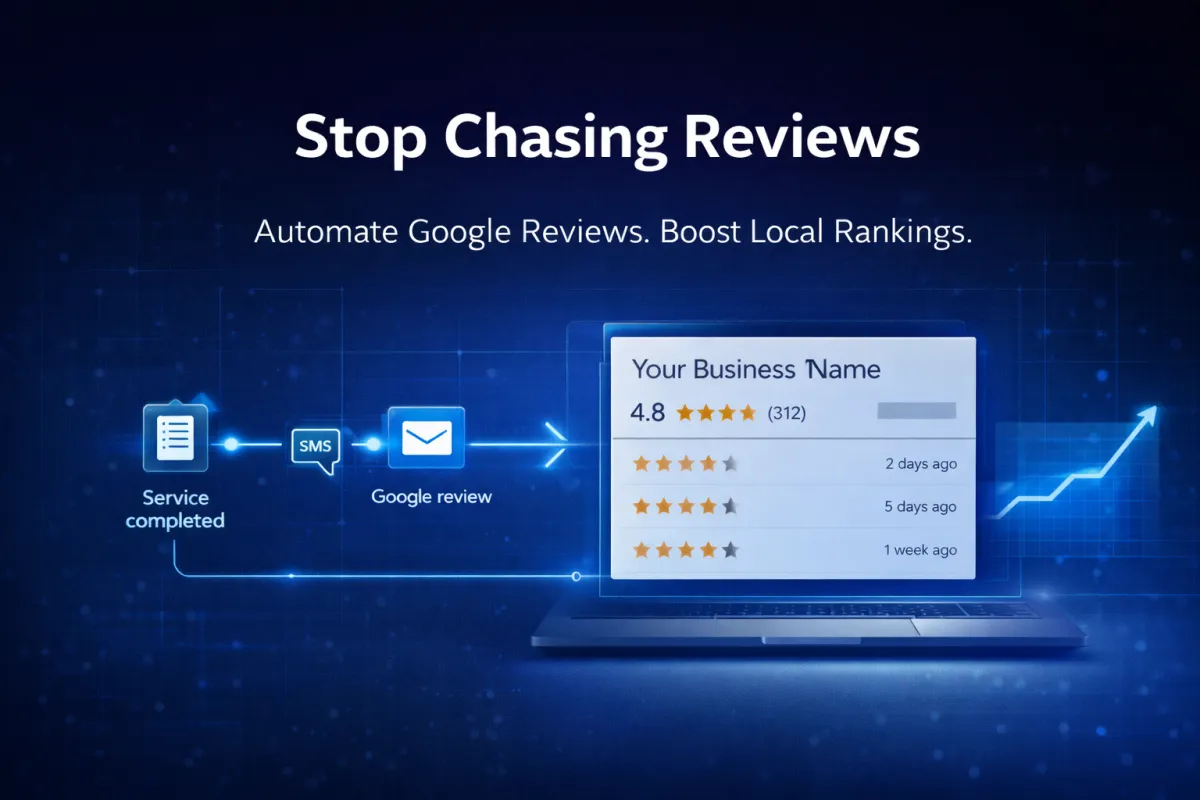
Step one: A trigger fires after a service is complete. When a job is marked complete in your system, an appointment ends, or a payment is processed, the automation recognizes that a customer interaction has just concluded. This is the trigger point.
Step two: A review request goes out within minutes. The customer receives a message, most commonly via SMS or email, with a direct link to your Google Business Profile review page. The message is short, friendly, and makes the action as easy as possible. No searching required. One tap takes them directly to the review form.
Step three: A follow-up sends automatically if there is no response. If the customer does not leave a review within 48 to 72 hours, the system sends a second message. This follow-up is brief and non-pushy. It simply reminds the customer and provides the link again. A two-message sequence captures a significantly higher percentage of willing reviewers than a single request.
Step four: New reviews are flagged for response. When a review comes in, your team receives a notification. Responding to reviews, especially negative ones, is a ranking and trust signal in its own right. Customers spend nearly 50% more with companies that engage with their feedback, and 97% of potential customers read business responses to reviews.
This entire process runs without anyone on your team initiating it. The system handles outreach, timing, and follow-up automatically for every customer, every time.
The Channels That Work Best for Review Requests
Not all review request channels perform equally. The channel you use determines how many customers actually see the request and act on it.
SMS is the most effective channel for review requests. Text messages have an open rate above 90%, compared to email open rates that average around 20 to 30% for most service businesses. A review request sent via text gets seen almost immediately after delivery. A customer who has just had a good experience with your business is far more likely to tap a link from a text message than to open an email hours later.
Email works well as a secondary channel. For customers who do not respond to the text, an email follow-up increases the total conversion rate. Email also allows for slightly more context, which can be useful if the customer had a longer or more complex interaction with your business.
WhatsApp is effective for businesses with a customer base that uses it actively. In markets where WhatsApp is a primary communication channel, a review request sent through that platform performs comparably to SMS.
A well-built SMS, email, and WhatsApp automation system sends review requests through the channel that works best for each customer based on how they have interacted with your business previously. This increases the total number of reviews collected per month without any additional effort from your team.
How Review Volume Affects Local Search Rankings Over Time
Review collection is not a one-time effort. It is a continuous process that compounds over time.
The moment a business stops getting new reviews, local rankings start to slip. When new reviews come in consistently, rankings improve. When they stop, rankings drop. There is a direct correlation between the presence of new reviews and where a business ranks.
This means the businesses that win the most local search visibility are not the ones with the most total reviews. They are the ones with the most recent and most consistent flow of new reviews. A business with 200 reviews, most of which are two years old, often ranks below a competitor with 80 reviews that are mostly from the last 60 days.
According to the 2026 Local Search Ranking Factors survey from BrightLocal and Whitespark, reviews, citations, and authority signals also have a significant impact on how businesses appear in AI-powered search results, meaning the importance of review signals extends beyond traditional Google search into the newer AI-driven search experiences customers are increasingly using.
Automated Google reviews address this directly because the system runs continuously. Every customer who completes a service receives a request. Every week produces new reviews without any manual effort. The result is a steady, compounding improvement in both review volume and review recency.
Integrating Reviews Into Your Broader Automation System
Review collection works best when it is connected to the other systems running your business, not operating as a separate tool.
When your CRM and sales pipeline tracks customer status in real time, the review automation system knows exactly when a job is complete, which customer it was, and what channel to use for the request. The review request goes out at the right moment based on what is actually happening in your business, not on a fixed schedule.
When your Voice AI handles inbound calls and books appointments, those appointments feed back into your CRM. The customer's contact information and communication preferences are already logged. When the appointment concludes, the review request triggers automatically through the channel that customer has already engaged with.
This level of integration eliminates the gaps that exist when tools operate in isolation. The review system always has accurate data. It always knows which customers to contact. And it always sends requests through the best available channel without anyone on your team managing the process manually.
GoFullAI builds these integrations from the ground up as part of a complete business automation system. The goal is not to add a review tool on top of what you already have. It is to build a connected system where every part of your operation, from the first inbound call to the post-service review request, runs automatically and feeds into a single source of truth.
What to Do With Negative Reviews
No business receives only five-star reviews. Negative reviews are inevitable, and how you handle them matters as much as how many positive reviews you collect.
53% of customers expect a response to negative reviews within one week, and 67% of dissatisfied customers remain loyal when a business responds quickly. A negative review that receives a professional, empathetic response often does less damage than a negative review that receives no response at all.
An automated review system should notify your team the moment a review comes in below a certain star rating. That notification prompts a fast, personal response. The review itself stays on your profile. The response shows every future prospect that your business takes feedback seriously and follows through.
Over time, a consistent pattern of thoughtful responses to negative reviews, combined with a high volume of positive reviews, produces a profile that builds trust effectively.
Getting Started With Review Automation
The fastest path to more Google reviews is a system that runs without depending on anyone to remember to ask. That system starts with connecting your customer data, choosing your messaging channels, setting your trigger points, and writing the request messages your business will use.
Most service businesses can have a fully functional review automation system running within one to two weeks. Once it is live, it requires no day-to-day management. Reviews come in. Your team responds to them. The system keeps asking new customers automatically.
According to BrightLocal's Local Consumer Review Survey, 98% of consumers read online reviews before choosing a local business, and 81% specifically check Google reviews before making a decision. Every week your review system is not running is a week your business is invisible to a significant portion of the customers looking for exactly what you offer.
If you want to see how automated review collection would work for your specific business, book a free 15-minute discovery call. You will get a clear picture of what the system looks like, how quickly it can be set up, and what kind of results other businesses in your industry have seen.


